
The Shield Wall
You were not meant to fight alone
Isolation is not an accident of modern life. It is the thirteenth rule — pick the target, freeze it, personalise it, polarise it — and it works because the person standing alone in a meeting has nobody to look at when the room turns.
Everything below is the answer to that one tactic. Not a feed to read. A place to stand, with people who know your name and a city you are actually responsible for.
One
A room for your city. And one for your state.
Every metro and every state where somebody stands is a room. Nobody founds one, nobody approves one, and there is no directory of empty channels to keep up with. You are in two at once, because they fight different battles: a school-board adoption is metro, a statute is statewide.
Inside a room you get the alerts live on that ground — your metro’s, plus the statewide ones that land on it — and the people working the same problem. Threads, so an answer sits under its question. A daily digest, but only on days somebody actually posted; ten posts on the night of a board meeting will never be ten emails.
Your name appears only if you choose it. Turn anonymity on and it applies backwards as well as forwards — to everything you have already written. These are people dissenting inside their own churches and schools, and that has to actually work.
Two
When your city reaches 10, it can have a Captain
Below ten members a Captain is a title without a job. At ten, the city gets flagged as ready and somebody is appointed — founding members first, which is the whole reason founding costs what it does. A city only has one.
A Captain can do four things:
- Run the room — pin what matters, remove what doesn’t.
- Add local context to any alert on their ground — appearing beside the alert, attributed and dated, never inside the editorial text. The superintendent who already resigned; the meeting that moved.
- Send in an alert the scan missed. It enters the same review queue everything else does.
- Propose a rally call. Propose — not send. A rally is an email to a whole metro under the editor’s name, so it is approved by hand, every time.
A Captain can stay anonymous and still be reachable: messages go through the site, so neither of you ever sees the other’s address.
Three
The answers, and the exact question to send
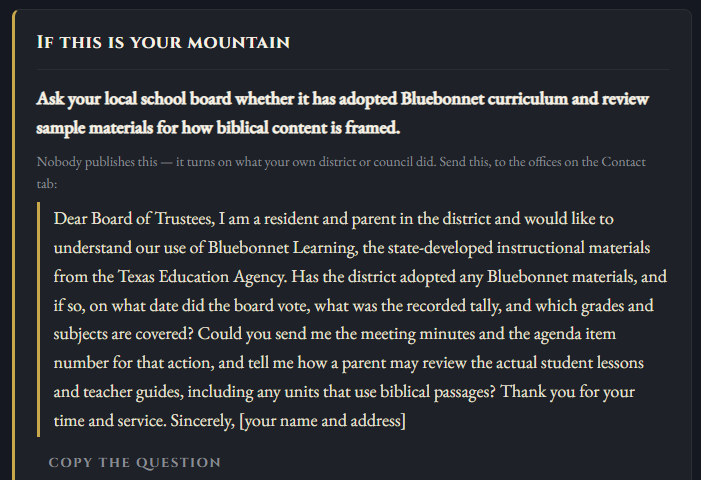
Every alert ends with things you are told to go and find out. On 216 alerts, those have been researched — 811 of them.
Where the public record settles it, you get the answer with the page it came from and the date. Where it does not — and most of what matters turns on what one board did on one night, which is published nowhere — you get the exact message to send, naming the statute and asking for the date, the recorded tally and the minutes. Worded so it has to be answered with a fact rather than a sentiment.
That second kind is not a failure to research. A member who asked and was stonewalled stands on firmer ground than one who read a confident paragraph about somewhere else.
Four
Who to call, with the page it came from
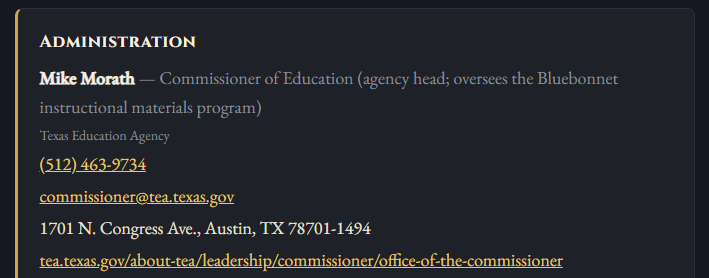
When an alert becomes a rally call, it is researched for the official published channels of the body actually deciding it: elected members, administrators, boards and trustees, by name and office, each with the source and the date it was gathered. 24 such contacts are live on the site today.
Office phone, public email, mailing address — the lines these bodies maintain precisely so the public can reach them.
Never a home address, a personal mobile, or a family member. Not for anyone, at any time. A letter to the address on the record enters the minutes; a call to a house at dinner makes the story the harassment instead of the curriculum.
Five
Which rule is being run, and the counter from the book
Each alert is read for the Alinsky rules actually in play — at most three, because a framework that explains everything explains nothing. For each you get how it is showing up in that specific story, and the matching counter-rule applied to that situation: what to read, who to ask, what to write down, what to refuse.
Chapter 3 sets out the rules; Chapter 15 answers each in turn. The pairing is fixed in the book, so the counter is never invented — Counter-Rule 8 always answers Rule 8.
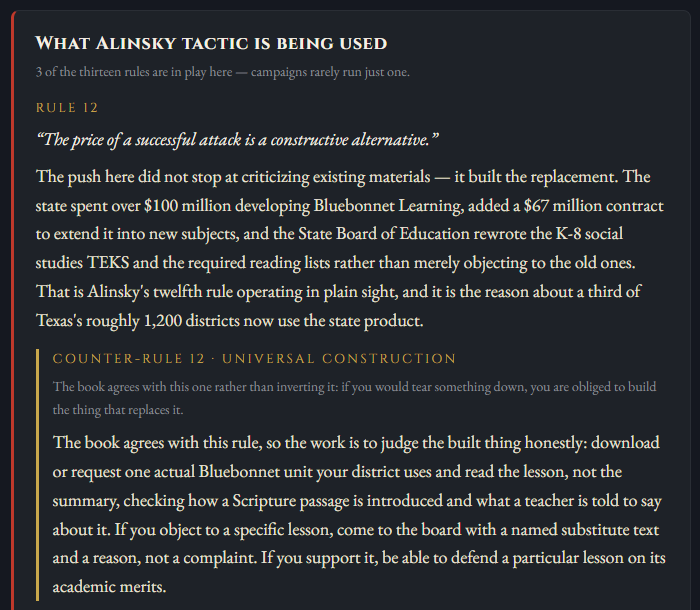
The same reading goes out on video: a briefing for every alert, and the Field Cases — 14 so far — where a believer in a real bind says the exact words that change the ground the fight is on. From the Desk is the column that reads the week whole.
Six
When it happens to you: Ask
The alerts are about somewhere else until the day the notice has your name on it. Ask is for that day. Describe the situation in your own words — the statement you are told to sign, the unit your child cannot opt out of, the rule at church — and attach the document if there is one. In a minute or two you have the answer: which technique is being run on you, the holes in their argument, what their own document gives you, what the book and Scripture say, the law in your state with its sources, and the exact words to say, in order, with their own sentences read back to them.
Then it stays open. When they answer, you bring the answer back and get the next step, before it ever needs a lawyer — and it tells you plainly when it does.
Your first ask is free with an account. Members get five a month. Read a full sample answer →
Seven
The school — six disciplines, 62 modules, open now
The Core Course teaches the book, one module per chapter, so you always know where you are and the two reinforce each other. Beside it stand four more disciplines: Logical Reasoning (arguments, fallacies and manipulation, named and answered), Alinsky Studies (the man behind the rules — his life, his books, his heirs), Apologetics (defending the faith system by system — secularism, Islam, Catholicism, Buddhism and more), and Witnessing (from knowing the answer to giving it). The teaching is new material throughout, not the book quoted back at you: if you have read it, you will still learn something.
And for founding members alone, the sixth discipline: The Parallel Polis — A Builder’s Course — nine modules on building the City of Truth beside the captured institutions, from Benda and Charter 77 through the three modes of construction and the immunities that keep an institution yours for fifty years, ending in your own private Founder’s Charter. What it is, in full →
Every module runs the same five steps:
- Brief — why this matters, in a paragraph.
- Teaching — the operating instructions the book’s doctrine implies.
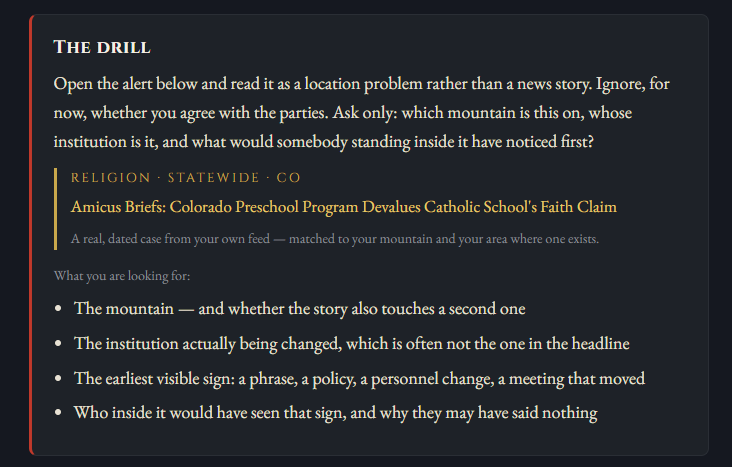
- Drill — worked against a real, dated alert from the feed, matched to your mountain and your city. Two students take the same module and work different live cases.
- Artifact — the thing you produce and keep.
- Check — a few questions. Free to retry; there is no grade.
The artifact is the point. You finish holding a written jurisdiction for your household, your district’s adoption calendar, your institution’s undefined words, your own ethical line with a date on it, and a reform-or-rebuild verdict you have had to argue against. Not a page of notes — equipment.
The Core Course’s first four modules — and the first module of every other discipline — are free with an account, and they carry the same weight as the paid ones. Phase 5 routes you to your own mountain first. One membership opens five of the six disciplines; the Builder’s Course belongs to founding members, and the Core Course’s last four modules join the Builder tier when they are written — included with Founding.
Where it starts
Four minutes, and everything sorts itself to you
The assessment finds your mountain and your institution’s capture phase. It is what makes your alerts arrive matched, your rooms be the right two, your school route to your own ground, and the rally calls that reach you be the ones you could actually turn up to. It is free, it needs no card, and some results come back saying your institution looks healthy — because a diagnostic that always finds a problem is not a diagnostic.
Where this actually stands today: 216 alerts published, 2 of them rally calls, members standing in 3 states. Early, and we would rather say so than dress it up. The people joining now are the ones who decide what this becomes — and who get first refusal on their own city.
How to join it
The alerts stay free forever, and so do your first ask and the first modules of every discipline. Membership is $24.99 a month, or $249 a year, and covers everything above, five asks a month included. Founding membership is $197 a year, locked for life, and carries first refusal to be Captain of your city — the one thing here that cannot be bought later at any price.
A church or a ministry can carry a link of its own; a portion of every membership that comes through it goes to its ministry fund.
The antidote to Alinsky is not better Alinsky. Nothing here is a call to confront anyone personally — it is lawful civic engagement, on the record, through the proper channel, done by people who know each other’s names.